
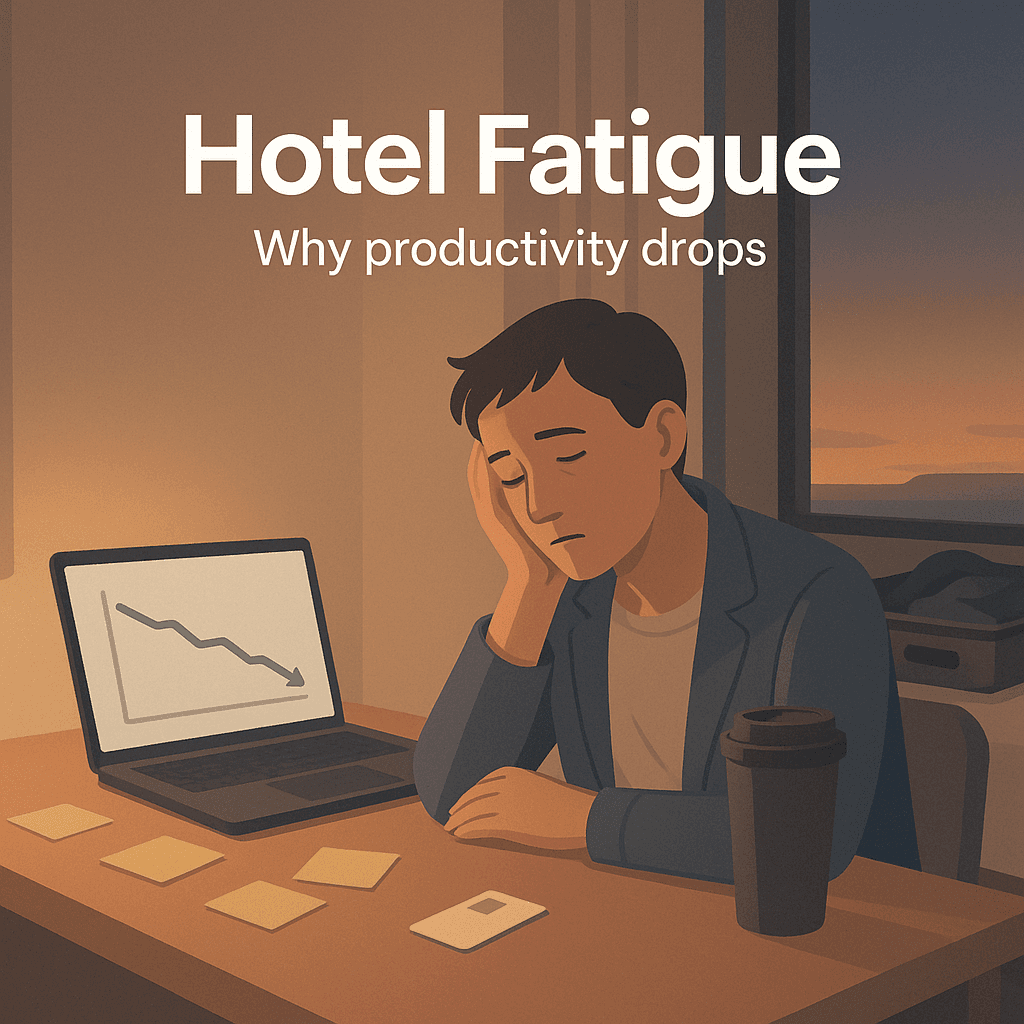
There’s a specific kind of tired that hits when you have been living out of a suitcase for too long.
Not the normal end of day tired. I mean that weird, foggy, slightly irritated feeling where simple things start to feel… harder than they should. You miss a meeting because you forgot what time zone your laptop thinks you are in. You open your notes and realize you wrote down the same to do twice. You are technically “fine”, you are sleeping, you are showing up. But your output drops anyway.
A lot of people blame themselves for this.
But a big chunk of it is the environment.
It’s what I call hotel fatigue. And it shows up constantly with long assignments, relocations, training blocks, government travel, contractor work, military adjacent travel. Anyone doing a 30 day plus stay knows the vibe.

What “hotel fatigue” actually is
Hotel fatigue is that slow burn stress that comes from living in a space that is designed for passing through, not for living.
Hotels are optimized for:
- quick check ins
- short stays
- minimal personal setup
- standardized layouts
- cleaning schedules that are not yours
That’s great when you are in town for two nights.
But when you are there for 30, 60, 90 days. It starts to mess with the basics that keep you sharp. Routine, control, comfort, focus. The stuff you do not notice until it is missing.
And it is not just mental. Your body notices too.
Why productivity drops in extended stay hotels (even when the room is “nice”)
1. Decision fatigue from tiny daily workarounds
In a hotel, you do little mental math all day.
Where do I take this call so I am not bothering people.
Where can I sit so my back does not hurt.
What can I eat that is not depressing.
Do I have time to do laundry somewhere or do I pay the hotel rate again.
Is the WiFi going to be weird tonight.
None of these decisions are huge. That’s the point. It’s the constant stream of small friction that drains you.
At home, your brain runs on autopilot for a lot of life. In a hotel, autopilot is gone.
2. Sleep is lighter than you think
Hotels are full of subtle sleep disruptions.
- hallway doors
- random footsteps overhead
- elevator noise
- inconsistent room temperature
- blackout curtains that are not actually blackout
- a mattress that is fine but not your fine
And sleep quality is the foundation of work quality. You can be “in bed” for 8 hours and still wake up feeling like you ran a low grade marathon.
After a couple weeks, you get this background fatigue that bleeds into everything.
3. You never fully unpack, so your brain never fully settles
This is underrated.
When you do not unpack, you stay in a permanent state of transition. Your stuff is half in a bag, half on a chair, half on a tiny desk.
Your mind treats that as temporary. Temporary is stressful. Temporary keeps you on alert. It is like your nervous system refuses to exhale.
And you might not even notice it until you get home and suddenly feel human again.
4. Food becomes a problem instead of a recharge
People underestimate how much energy gets burned just trying to eat decently in a hotel.
Even with “free breakfast” or a kitchenette, you end up with:
- too much takeout
- too much sodium
- not enough protein or fiber
- inconsistent meal timing
- spending way more money than you planned
Now stack that with long workdays. Training. Early mornings. Commutes.
Productivity dips fast when your meals are random and your blood sugar is on a rollercoaster.

5. You do not have separation between work mode and rest mode
Hotels are basically one room living.
You work on the same surface you eat on. You eat two feet from the bed. You take calls next to the TV.
So you never really shut off.
And if you are on an assignment where you need to stay sharp day after day. This gets expensive. Not in money. In mental energy.
6. “Background noise” becomes background stress
Even if you are not a sensitive person, hotel living means constant micro interruptions:
- housekeeping knocks
- people talking in the hall
- ice machine noise
- parking lot activity
- thin walls
- lobby crowds
When your environment is unpredictable, your brain stays semi vigilant. You can still work. Sure. But focus is not as deep, and recovery is not as complete.
The hidden cost: it looks like laziness, but it is actually load
This is the part that bugs me.
Hotel fatigue makes good people feel like they are underperforming. You start thinking you lost discipline. That you are not motivated. That you “should” be able to power through.
But if your environment is constantly adding friction, your output will drop. That’s not a character flaw. That’s just math.
If you are on a longer assignment near Marine Corps Base Quantico, or doing month to month contractor work in the area, you want your housing to reduce load. Not add to it.
A more livable setup: why a furnished home changes the equation
A furnished short term rental home is not just “more space”. Space is part of it, but the bigger deal is control.
Control looks like:
- a real kitchen where you can cook like a normal person
- a washer and dryer so laundry is not a project
- separate bedrooms so sleep stays protected
- a living room so you can leave work behind
- driveway or garage parking so you are not hunting for a spot
- a quiet residential setting where nights feel calmer
And that stack of small improvements adds up to a big productivity bump.
Not because it’s fancy. Because it removes friction.

What to look for if you are trying to avoid hotel fatigue
If you are booking a 30 day plus stay, here are the practical things I would screen for. Like, non negotiables.
A real kitchen (not just a microwave and mini fridge)
You want:
- full size fridge
- stove and oven
- basic cookware
- counter space that makes cooking realistic
Even if you only cook 3 times a week, it stabilizes everything. Energy, mood, budget.
In home laundry
The laundry part is sneaky. When you have to leave your building to do it, laundry becomes delayed. Then you buy extra clothes. Then you have clutter. Then you feel disorganized.
In home laundry keeps life smooth.
Dedicated workspace
A table you can sit at for hours. Good lighting. Enough room to spread out without living in a mess.
Quiet nights
If you are working early mornings or long shifts, quiet is not a luxury. It is performance support.
Parking that doesn’t stress you out
If you are near Quantico, you might be driving daily. Easy parking matters more than people think, because it is one less annoying thing your brain has to solve.
So where does Quantico Short Term Rentals fit in?
If you are coming to the Triangle, Virginia area for a longer stay near Marine Corps Base Quantico, this is basically the exact scenario where hotels start to wear people down.
Quantico Short Term Rentals is positioned as an alternative to extended stay hotels for 30 day plus and month to month stays. Fully furnished private homes, multiple bedrooms, full kitchen, washer and dryer, garage and driveway parking, quiet residential setting. The whole point is to make the stay feel livable, not temporary.
If you want to check what’s available, view a virtual tour, or just see if the timing lines up with your assignment, you can start here:
https://quanticoshorttermrentals.com
No pressure. Just… it’s worth comparing the total cost of “hotel living” against a setup that actually supports sleep, routine, and work.
A quick self check: are you already feeling it?
If you are not sure whether hotel fatigue is hitting you, here are a few signals that tend to show up first.
- You feel restless even after sleeping
- Your work takes longer than it normally would
- You avoid cooking because it feels annoying
- You are spending more on food than you expected
- You feel like you can’t fully relax in the room
- You keep thinking “once I get home, I’ll get back on track”
That last one is the big tell.
Because a good temporary housing setup should let you stay on track while you are away. Not pause your life until later.
The real takeaway
Productivity drops when your environment demands extra effort just to live.
Hotels are good at being hotels. They are not great at being a home base for real life, real work, real recovery. Not for long.
So if you are on a longer assignment near Quantico, and you are trying to protect your energy, your focus, your sleep. Consider the boring sounding upgrades that are actually huge.
A kitchen. Laundry. Space. Quiet. A place that lets your brain stop scanning and start settling.
That’s the fix for hotel fatigue, most of the time.
And if you want to explore a furnished home option built for 30 day plus stays in the Triangle area, you can check availability with Quantico Short Term Rentals here: https://quanticoshorttermrentals.com
FAQs (Frequently Asked Questions)
What is ‘hotel fatigue’ and how does it affect long-term travelers?
Hotel fatigue is a specific kind of tiredness that occurs when living in a hotel for an extended period, typically 30 days or more. It’s characterized by a foggy, slightly irritated feeling where simple tasks become harder, productivity drops, and mental sharpness declines due to the transient nature of hotel environments not designed for long-term living.
Why does productivity drop during extended stays in hotels even if the room is nice?
Productivity drops because of factors like decision fatigue from daily workarounds, lighter and disrupted sleep quality due to noise and unfamiliar beds, never fully unpacking which keeps the brain in a constant state of transition, poor nutrition habits from limited food options, lack of separation between work and rest spaces, and constant background noises causing stress and reduced focus.
How does decision fatigue manifest when living in a hotel long-term?
In hotels, individuals face numerous small decisions daily—such as finding quiet places for calls, managing back discomfort by choosing seating wisely, figuring out meal options that are not depressing, handling laundry logistics, and dealing with inconsistent WiFi. These continuous minor challenges add up mentally and drain energy over time.
What are some common sleep disruptions experienced in hotels that contribute to hotel fatigue?
Common sleep disruptions include hallway doors slamming, footsteps overhead, elevator noises, inconsistent room temperatures, blackout curtains that don’t fully block light, and mattresses that are comfortable but not personalized. These factors lead to lighter sleep quality which undermines overall work performance.
How does staying in a furnished short-term rental home help alleviate hotel fatigue?
Furnished short-term rentals offer greater control over living conditions with features like real kitchens for proper cooking, washers and dryers for easier laundry management, separate bedrooms for better sleep protection, living rooms to separate work from rest areas, private parking spaces, and quieter residential settings. This setup reduces mental load and helps maintain routine and comfort.
Why do people often mistake hotel fatigue symptoms for laziness or lack of discipline?
Because hotel fatigue leads to decreased output despite consistent effort—like showing up on time and sleeping—people may wrongly believe they have lost motivation or discipline. However, the drop in productivity results from environmental stressors adding mental friction; it’s a natural response to prolonged exposure to transient living conditions rather than a character flaw.